25 words or less is the ultimate guide for anyone who wants to communicate clearly and concisely.
Whether in emails, social media, or essays, writing within 25 words makes your message sharp, effective, and easy to read.
This article explains what it means, common mistakes, and practical tips to master concise writing.
Which One Is Correct – 25 Words or Less or 25 Words or Fewer?
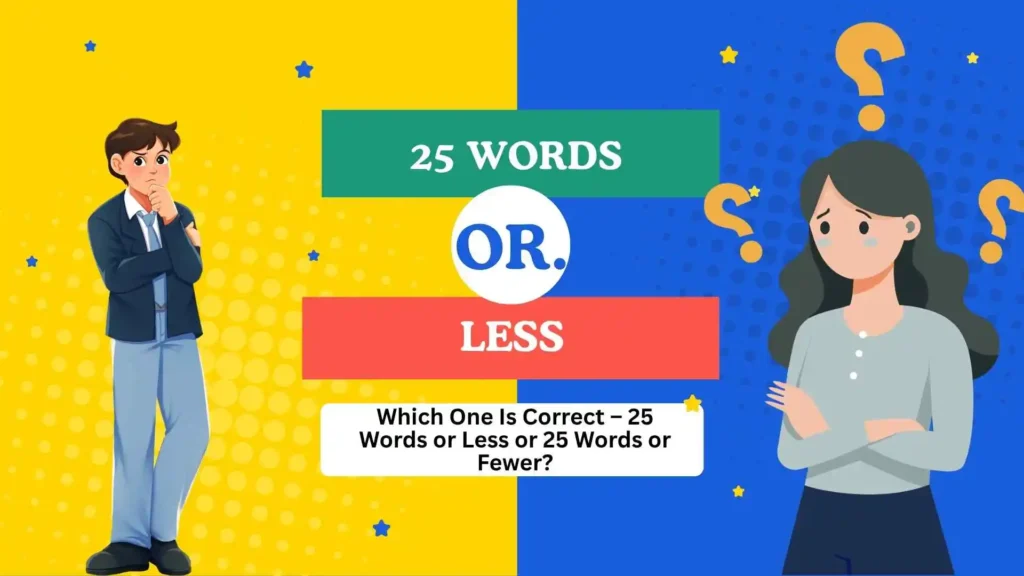
The correct and most widely accepted form is 25 words or less.
Although some grammarians suggest using “fewer” for countable nouns, 25 words or less is simpler, more natural, and reader-friendly.
- Using “25 words or fewer than” is incorrect because “than” is unnecessary when paired with “less” or “fewer.”
Meaning of 25 Words or Less
25 words or less simply means that your sentence, paragraph, or message should not exceed 25 words.
It is often used in writing instructions, social media posts, contests, or guidelines where brevity is important.
Examples:
- Summarize your idea in 25 words or less.
- The essay must be 25 words or less.
- Write a social media caption in 25 words or less.
- Answer the survey in 25 words or less.
- Introduce yourself in 25 words or less.
Meaning of 25 Words or Fewer
Some writers prefer 25 words or fewer when referring to countable words.
- “Fewer” is technically correct for countable nouns like words, sentences, or items.
- Both forms are widely understood, but 25 words or less is more common and easy to read.
Examples:
- Limit your comments to 25 words or fewer.
- Summarize the paragraph in 25 words or fewer.
- Only include relevant points in 25 words or fewer.
- Your tweet should be 25 words or fewer.
- Keep your description in 25 words or fewer.
Why Do People Confuse Less and Fewer?
Confusion happens because:
- Spelling similarity – Less and fewer look alike.
- Pronunciation – Both words sound simple and familiar.
- Typing mistakes – Writers often add “than” or mix forms incorrectly.
Just 25 Words or Less – Is It Correct?
Yes! Saying just 25 words or less is correct.
- The word “just” emphasizes the limit.
- Common mistakes include:
- Just 25 words or less than ❌
- Only 25 words or fewer than ❌
Correct usage:
- Summarize just 25 words or less. ✅
Easy Trick to Remember the Difference
Use this simple tip:
- Use less for general limits, like time, space, or word count.
- Use fewer for countable items, like words, apples, or points.
Memory tip: “Fewer = countable things, Less = general limits.”
Related Phrases with 25 Words or Less
- In no case: In no case should your comment exceed 25 words or less.
- In any case: In any case, keep your message 25 words or less.
- In that case: In that case, rewrite your sentence to 25 words or less.
Common Misspellings
| Correct | Incorrect |
| Separate | Seperate |
| Definitely | Definately |
| Receive | Recieve |
| Accommodate | Acomodate |
| Occurrence | Occurence |
| Embarrass | Embarass |
| Committee | Commitee |
| Necessary | Neccessary |
| Consensus | Concensus |
| Maintenance | Maintanence |
| Recommend | Reccomend |
| Independent | Independant |
| Privilege | Privelege |
| Believe | Beleive |
Frequently Asked Questions
Is 25 words or fewer ever incorrect?
It is not incorrect but less common and may sound formal.
Is it one word or two?
“25 words or less” is a phrase, not a single word, and should be written as shown.
Can I use it in formal writing?
Yes, especially in guidelines or instructions, though “fewer” is sometimes preferred.
What does it mean?
It means the sentence or message should not exceed 25 words.
Can I say just 25 words or less?
Yes, “just” emphasizes the limit and makes the phrase clearer.
Conclusion
Using 25 words or less is a simple and effective way to communicate clearly. Always use the correct form, avoid extra words like “than,” and keep your writing concise. Following these tips ensures your message is clear, professional, and easy to read.

Hi, I’m Robert Hayes, a lifelong word enthusiast and grammar geek. Ever since I can remember, I’ve been fascinated by the way words shape our thoughts and communication. Over the years, I’ve dedicated myself to exploring English grammar in depth, helping readers understand it in simple, practical ways. When I’m not editing or writing, you can find me buried in a classic novel or experimenting with creative writing exercises. My goal is to make grammar approachable, fun, and empowering for everyone. Sharing my knowledge has been a passion, and I love seeing others improve their writing one sentence at a time.
Books by Robert Hayes:
-
Mastering English Grammar: A Practical Guide
-
The Writer’s Toolbox: Grammar and Style Essentials