Anytime or any time — which one should you use?
This small grammar difference confuses many writers. At first glance, both look correct. And honestly, both can be correct. But they are not used the same way.
Here’s the quick answer:
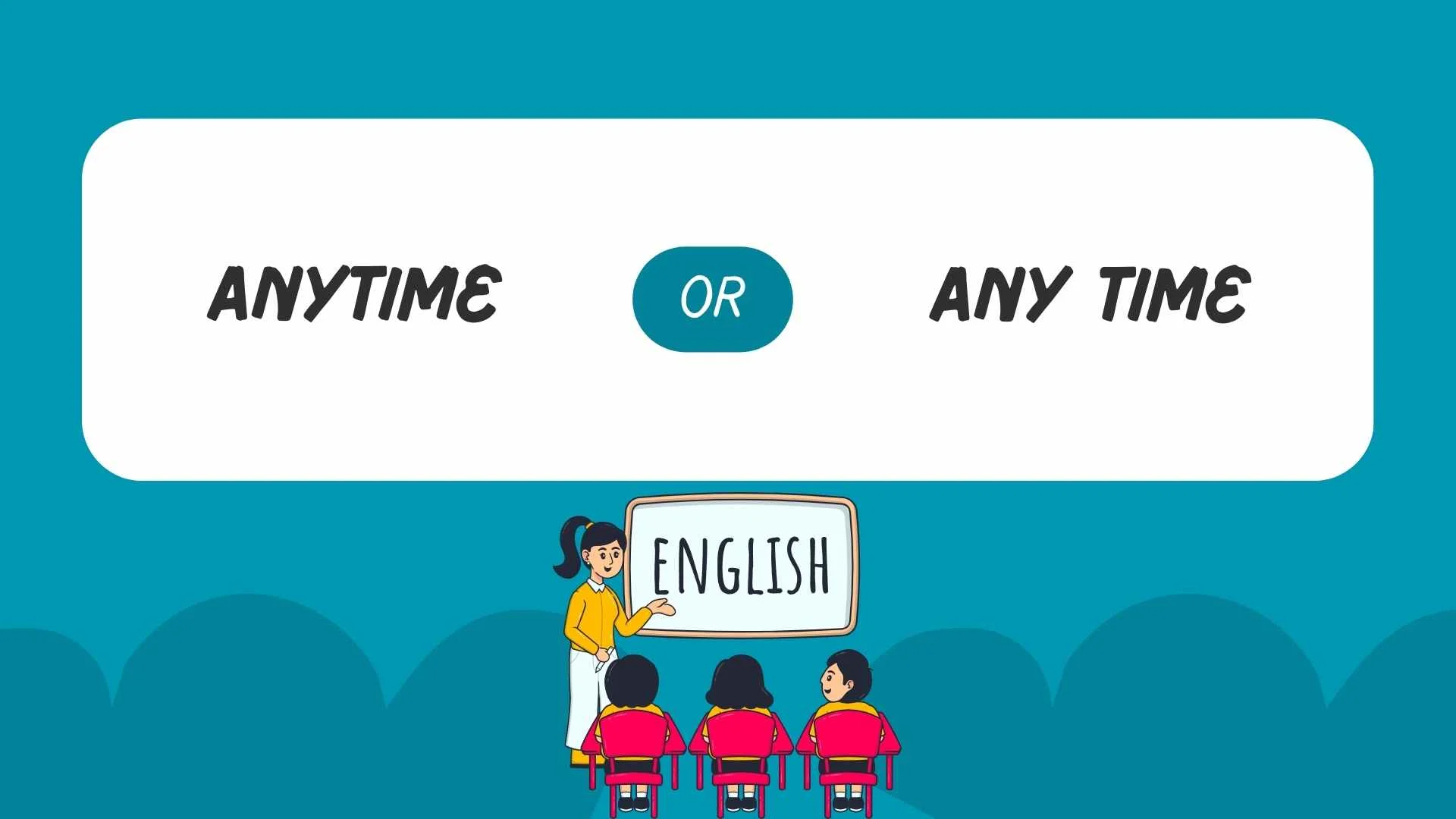
Use anytime as an adverb. Use any time when you need a noun phrase.
In this detailed guide, you’ll learn the exact difference, when to use each form, common mistakes to avoid, and an easy trick to remember it forever.
Let’s clear this up once and for all.
Which One Is Correct – Anytime or Any Time?
The correct answer depends on how you use it in a sentence.
- Anytime (one word) = Adverb
- Any time (two words) = Noun phrase
Quick Rule:
- Use anytime when it means whenever.
- Use any time when you are talking about an amount of time.
Example:
✔ Call me anytime.
✔ Do you have any time to talk?
Notice the difference? In the first sentence, “anytime” replaces “whenever.” In the second, “time” is a noun.
So neither is wrong. You just need the right one for the sentence.
Meaning of “Anytime”
Anytime is an adverb. It means whenever or at any moment.
You use it to describe when something can happen.
Simple Definition:
Anytime = At any moment / Whenever
It modifies a verb. That’s the key.
Examples:
- You can visit us anytime.
- Call me anytime you need help.
- I’m available anytime today.
- Feel free to stop by anytime.
- She can arrive anytime after 5 PM.
In each sentence, “anytime” tells us when something happens. That makes it an adverb.
Pro Tip:
If you can replace it with whenever, then anytime is correct.
Example:
Call me anytime → Call me whenever ✔
Meaning of “Any Time”
Any time (two words) is a noun phrase.
It refers to an amount of time.
Simple Definition:
Any time = Any amount of time
It often appears after prepositions like:
- at
- in
- during
- before
- after
Examples:
- Do you have any time to talk?
- I don’t have any time this week.
- At any time, you can cancel.
- She didn’t waste any time starting the project.
- Is there any time left?
In these sentences, “time” is clearly a noun. That’s why we use two words.
Quick Test:
If you can add a word between “any” and “time,” use two words.
Example:
Do you have any free time? ✔
So it must be any time, not anytime.
Why Do People Confuse Anytime and Any Time?
This mistake happens for three main reasons.
1. Spelling Similarity
The words look almost identical. Just one space changes everything.
2. Pronunciation
We pronounce them the same way. There is no sound difference. So people write what they hear.
3. Common Typing Habits
Modern writing moves fast. People type quickly and rely on autocorrect. That often leads to mixing them up.
Also, many people assume shorter words are always correct. That’s not true.
Grammar depends on function, not length.
Just Anytime – Is It Correct?
You’ve probably seen sentences like:
- You can leave just anytime.
- He arrives just anytime.
Are these correct?
Sometimes yes. Sometimes no.
If “anytime” means whenever, then it works.
✔ You can call me just anytime. (informal)
However, in formal writing, it’s safer to write:
✔ You can call me at any time.
Important Note:
In formal English, especially in business or academic writing, “at any time” is often preferred over “anytime.”
Example:
✔ The policy may change at any time.
This sounds more professional.
So context matters.
Easy Trick to Remember the Difference
Here’s the simplest trick you’ll ever learn:
The “Extra Word” Test
If you can add a word between “any” and “time,” use two words.
Example:
Do you have any ___ time?
- any spare time ✔
- any extra time ✔
Since you can insert a word, it must be any time.
If you cannot insert a word, use anytime.
Example:
Call me anytime.
You cannot say “Call me any spare time.” ❌
So it must stay as one word.
Simple. Practical. Effective.
Related Phrases with “Any Time”
Let’s look at some similar phrases that confuse writers.
In No Time
Meaning: Very quickly.
Examples:
- She finished the work in no time.
- The kids fell asleep in no time.
In Any Case
Meaning: Anyway / Regardless.
Examples:
- In any case, we should leave early.
- He may not come. In any case, we’ll start.
At Any Time
Meaning: Whenever / At any moment.
Examples:
- The system may crash at any time.
- You can withdraw money at any time.
Any Time Soon
Meaning: In the near future.
Examples:
- Is he coming back any time soon?
- I don’t see change happening any time soon.
These phrases use any time because “time” acts as a noun.
Common Misspellings
Here are common grammar mistakes related to similar word pairs.
| Correct Form | Incorrect Form |
| anytime | any time (when adverb needed) |
| any time | anytime (when noun needed) |
| a lot | alot |
| every day | everyday (when noun needed) |
| everyday | every day (when adjective needed) |
| all right | alright |
| in case | incase |
| at least | atleast |
| no one | noone |
| each other | eachother |
| already | allready |
| tomorrow | tommorow |
| separate | seperate |
| definitely | definately |
| until | untill |
Many of these mistakes happen for the same reason — spacing confusion.
Frequently Asked Questions
Is “anytime” ever incorrect?
Yes. It is incorrect when you need a noun phrase.
Example:
Wrong: Do you have anytime to talk?
Correct: Do you have any time to talk?
Is it one word or two?
It can be both.
Use anytime as an adverb.
Use any time when referring to an amount of time.
Can I use “anytime” in formal writing?
Yes, but carefully. In formal contexts, many writers prefer “at any time.”
Example:
The agreement may end at any time.
What does “anytime” mean?
It means whenever or at any moment.
Example:
You can email me anytime.
What does “any time” mean?
It means any amount of time.
Example:
I don’t have any time this week.
Is “just anytime” correct?
It can be correct in informal English.
But in formal writing, “at any time” sounds better.
Conclusion
Now you know the difference between anytime and any time.
- Anytime = Adverb (means whenever)
- Any time = Noun phrase (refers to an amount of time)
If you remember the “extra word test,” you’ll never get confused again.
Clear grammar builds trust. It improves your writing. And it helps you sound confident.
So next time you write, pause for a second. Ask yourself:
Is this about “whenever”? Or is this about “an amount of time”?
That small space makes a big difference.

Hi, I’m Robert Hayes, a lifelong word enthusiast and grammar geek. Ever since I can remember, I’ve been fascinated by the way words shape our thoughts and communication. Over the years, I’ve dedicated myself to exploring English grammar in depth, helping readers understand it in simple, practical ways. When I’m not editing or writing, you can find me buried in a classic novel or experimenting with creative writing exercises. My goal is to make grammar approachable, fun, and empowering for everyone. Sharing my knowledge has been a passion, and I love seeing others improve their writing one sentence at a time.
Books by Robert Hayes:
-
Mastering English Grammar: A Practical Guide
-
The Writer’s Toolbox: Grammar and Style Essentials