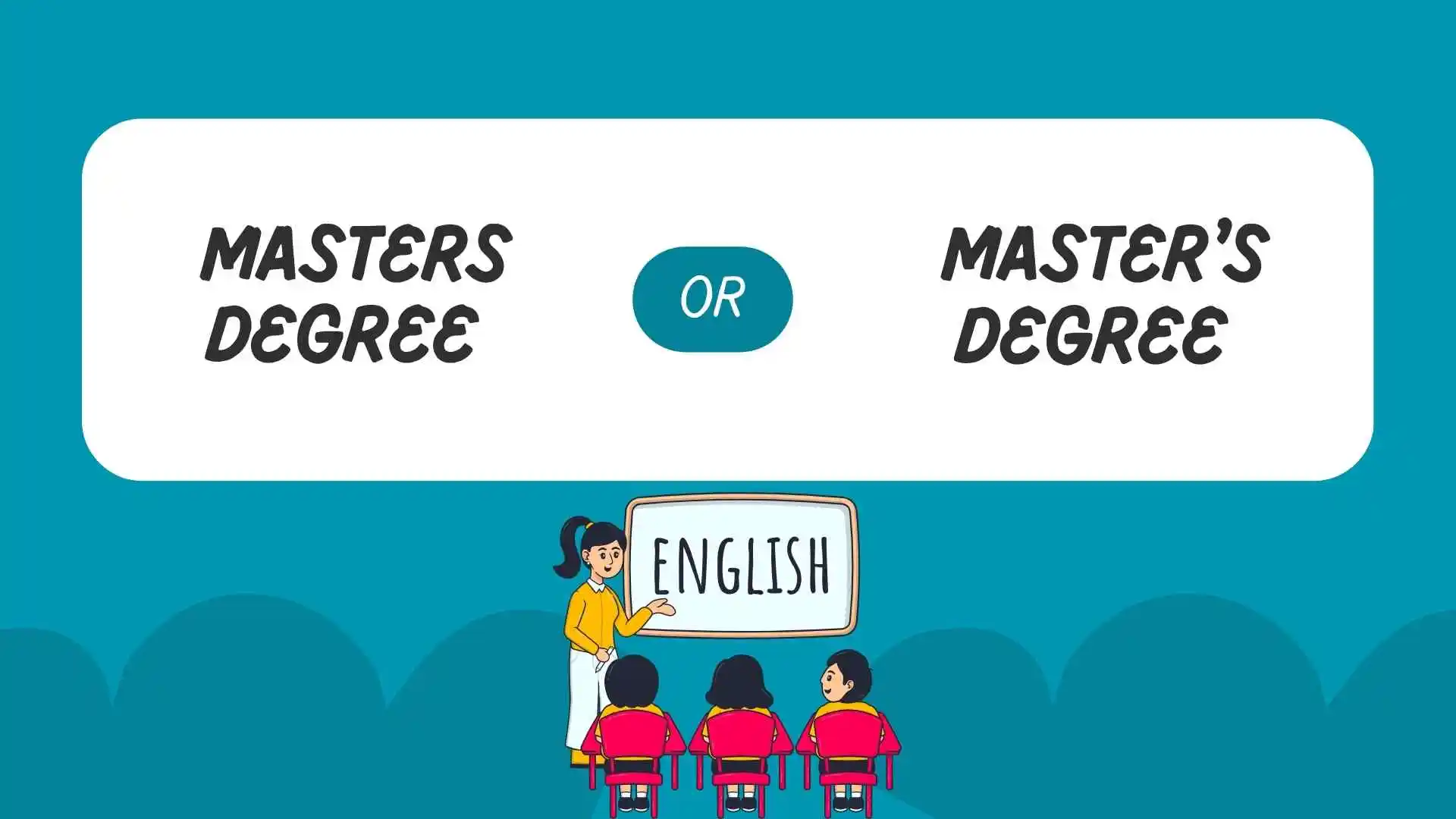
Master’s degree or masters degree — which one should you use?
This small difference confuses many writers, students, and even professionals.
The short answer is simple: “master’s degree” is correct, while “masters degree” is usually wrong in standard English.
In this guide, you’ll learn the correct usage, meanings, examples, common mistakes, and an easy trick to remember it forever.
Which One Is Correct – Master’s Degree or Masters Degree?
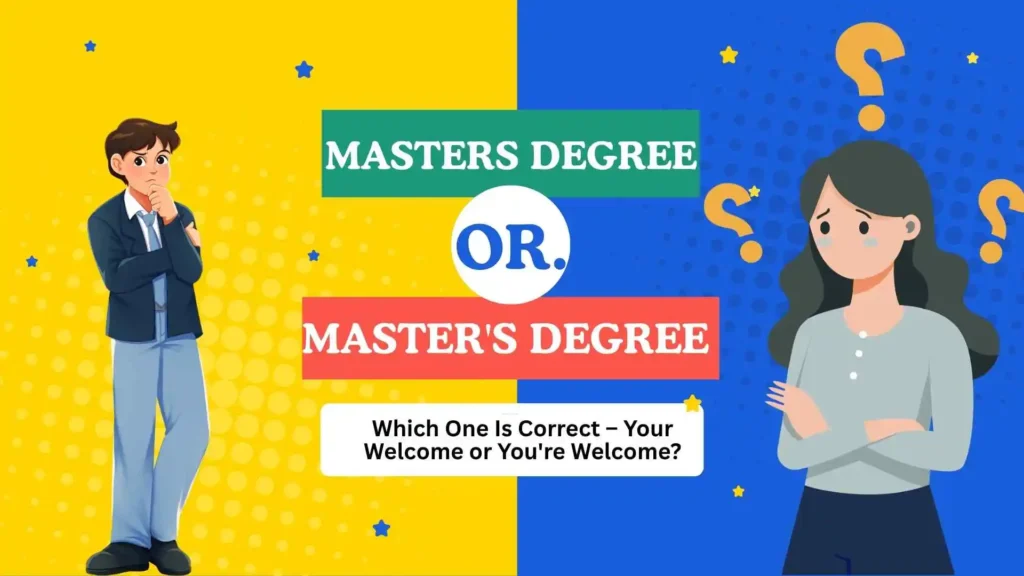
The correct form is: master’s degree ✅
The incorrect form is: masters degree ❌
Why is “master’s degree” correct?
Because “master’s” is a possessive noun, meaning “a degree of a master.”
- The apostrophe ( ’ ) shows ownership
- It indicates the degree belongs to the level called “master”
Why is “masters degree” wrong?
Without the apostrophe, “masters” becomes just a plural noun.
- It suggests multiple “masters,” not a degree
- It loses the grammatical meaning
👉 That’s why “master’s degree” is the standard and correct form in academic and formal writing.
Meaning of “Master’s Degree”
A master’s degree is an advanced academic qualification earned after completing a bachelor’s degree.
It usually takes 1–2 years and focuses on a specific field of study.
Simple Explanation
It means you have gained deeper knowledge and specialization in a subject after your undergraduate studies.
Example Sentences
- She earned her master’s degree in business administration.
- He is studying for a master’s degree in computer science.
- A master’s degree can improve your career opportunities.
- They completed their master’s degree abroad.
- You need a bachelor’s degree before applying for a master’s degree.
Meaning of “Masters Degree” (If Applicable)
Technically, “masters degree” without an apostrophe is incorrect in standard English grammar.
However, it may appear in:
- Informal writing
- Typing errors
- Non-native English usage
When is it seen?
You might see it in:
- Blog posts with poor editing
- Social media captions
- Search engine queries
Example Sentences (Incorrect Usage)
- ❌ She completed her masters degree last year.
- ❌ I want to apply for a masters degree program.
- ❌ He has a masters degree in psychology.
- ❌ They offer masters degree courses online.
👉 These should all be corrected to “master’s degree.”
Why Do People Confuse Master’s Degree and Masters Degree?
This confusion is very common, and here’s why:
1. Spelling Similarity
Both forms look almost identical.
The only difference is a small apostrophe, which many people overlook.
2. Pronunciation
When spoken, both sound the same.
- “master’s”
- “masters”
👉 This makes it harder to notice the grammatical difference.
3. Common Typing Mistakes
People often skip apostrophes while typing quickly.
- Especially on mobile devices
- Or when writing casually
4. Search Engine Habits
Many users search for “masters degree” on Google.
Even though it’s incorrect, it has become widely used in search queries.
Just Masters Degree – Is It Correct?
No, “masters degree” alone is not correct in formal English.
Correct Form:
- ✔ master’s degree
Incorrect Form:
- ❌ masters degree
Common Phrase Confusion
- ❌ I am doing my masters degree
- ✔ I am doing my master’s degree
👉 Always remember: you need the apostrophe.
Easy Trick to Remember the Difference
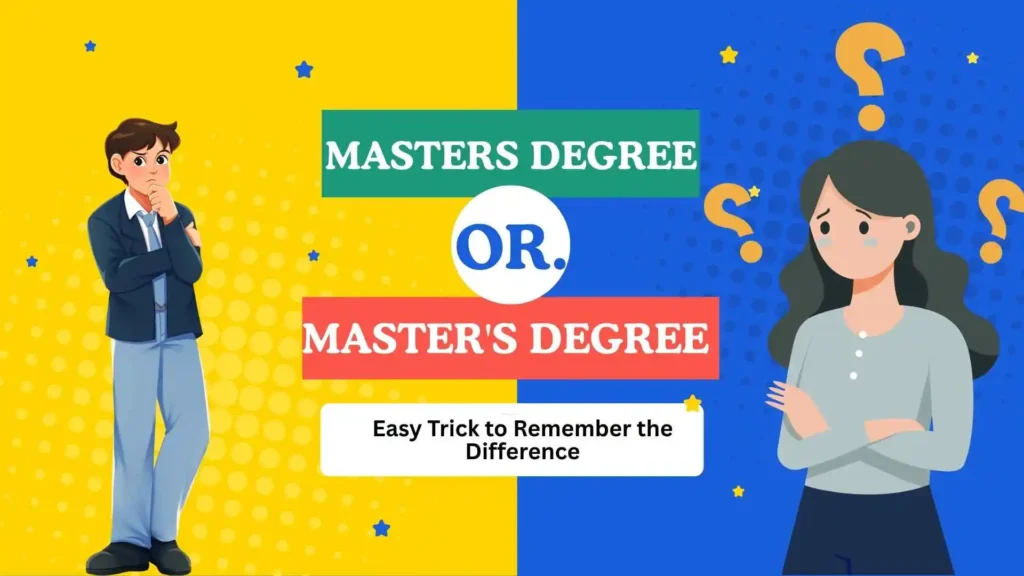
Here’s a simple memory trick:
👉 Think of it as: “degree of a master”
So you write:
➡ master’s degree (with apostrophe)
Quick Tip
If you can replace it with:
- “the degree of a master”
Then you must use ’s.
Related Phrases with “Master’s Degree”
Here are some useful phrases and how they are used:
1. In no case
Means: something is never allowed
- In no case should you write “masters degree” without an apostrophe.
2. In any case
Means: regardless of the situation
- In any case, using “master’s degree” is always safer.
3. In that case
Means: under that condition
- If you are writing formally, in that case, use “master’s degree.”
4. Pursue a master’s degree
- She plans to pursue a master’s degree in education.
5. Hold a master’s degree
- He holds a master’s degree in engineering.
Common Misspellings (Table Format)
| Correct | Incorrect |
| master’s degree | masters degree |
| bachelor’s degree | bachelors degree |
| doctor’s degree | doctors degree |
| it’s | its (when meaning “it is”) |
| your | you’re (wrong usage) |
| there | their / they’re (wrong context) |
| receive | recieve |
| separate | seperete |
| definitely | definately |
| environment | enviroment |
| government | goverment |
| accommodation | accomodation |
| business | buisness |
| education | educaton |
| writing | writting |
Frequently Asked Questions
1. Is “masters degree” ever correct?
No, it is not correct in standard English.
Always use “master’s degree” with an apostrophe.
2. Is it one word or two?
It is written as two words:
👉 master’s degree
3. Can I use it in formal writing?
Yes, but only the correct form.
Use “master’s degree” in essays, CVs, and academic documents.
4. Why is there an apostrophe?
The apostrophe shows possession.
It means “degree of a master.”
5. What about “Masters Programs”?
This is acceptable in some contexts like headings or titles.
But in full form, “master’s programs” is more grammatically correct.
6. Is “Master Degree” correct?
No, this is also incorrect.
Always use: master’s degree
Conclusion
The difference between master’s degree and masters degree is small but important.
The correct form is master’s degree, because it shows possession and follows proper grammar rules.
Using the wrong version can make your writing look unprofessional.
So, remember the simple trick: “degree of a master” = master’s degree.
Use it correctly, and your English will instantly sound more polished and accurate.

Andrew Wilson is a passionate writer and grammar enthusiast who has spent over a decade exploring the nuances of the English language. From dissecting sentence structures to understanding the evolution of words, he loves making grammar simple and enjoyable for everyone.
Writing has always been his way of connecting ideas, inspiring learners, and sharing the beauty of language. When he’s not teaching or writing, Andrew enjoys reading classic literature and experimenting with creative writing exercises. His mission is to help people communicate more effectively while having fun with grammar.
Books by Andrew Wilson:
-
Mastering English Grammar: A Complete Guide
-
The Joy of Words: Exploring Language with Fun