Have you ever come across this or that question on social media or in a fun icebreaker game and wondered why they are so popular? These questions are short, simple, and give people a way to express preferences quickly.
From Instagram polls to classroom activities, this or that questions have become a favorite tool for engagement.
People search for them because they want to create conversation, learn about someone’s choices, or just have fun while connecting.
The confusion often arises around how to use them effectively, what makes a good question, and whether there are rules for phrasing them.
Some people struggle with making their questions clear, fun, or relatable.
This guide explains everything you need to know about this or that question, including examples, common mistakes, and tips to create your own.
By the end, you’ll know exactly how to use these questions in daily conversations, social media posts, or games, making interactions more engaging and enjoyable.
This or That Questions – Quick Answer
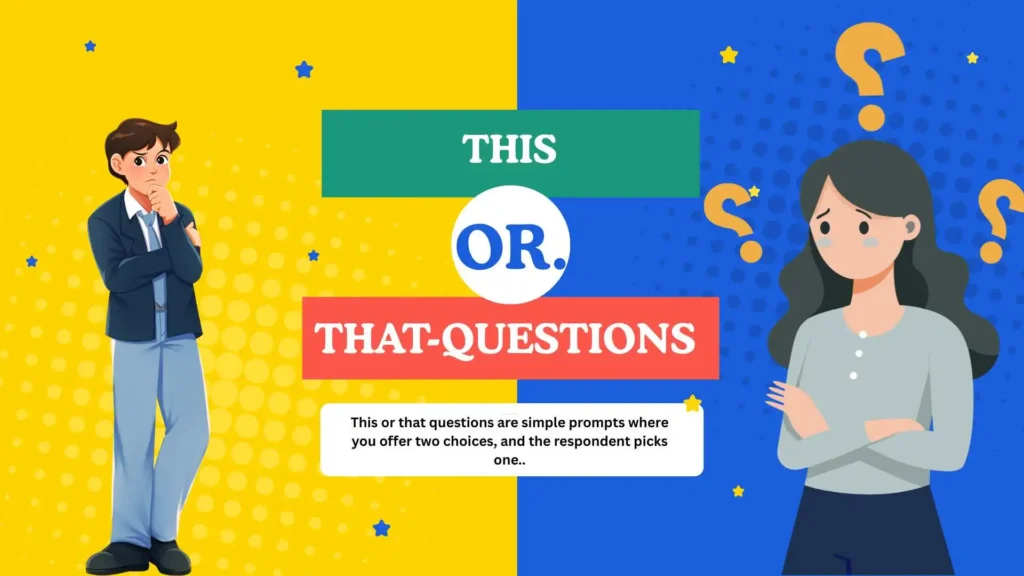
Quick Answer: This or that questions are simple prompts where you offer two choices, and the respondent picks one.
Examples:
- Coffee or tea?
- Summer or winter?
- Movies or books?
These questions are short, fun, and great for sparking conversation or social media engagement.
The Origin of This or That Questions
The phrase “this or that” is rooted in English language patterns for offering choices. It comes from the old English usage of contrasting options to encourage decision-making. Over time, it became popular in games, surveys, and online quizzes.
The concept is universal: giving two options simplifies decisions and makes interactions fast and engaging. There are no official spelling variations, but phrasing and punctuation can differ slightly depending on style guides or platforms.
British English vs American English Spelling
While this or that questions doesn’t have major spelling differences, the English style can affect phrasing and punctuation:
| Feature | American English | British English |
| Question mark placement | After the sentence | Same as American |
| Use of “and/or” | Common | Less common; prefer “or” |
| Capitalization | First letter of sentence | Same as American |
| Informal tone | Very common | Also common, slightly more formal in writing |
The main differences are style-related, not spelling-related.
Which Spelling Should You Use?
Since this or that questions is a neutral phrase, the “spelling” is universal. Use:
- American English if your audience is in the U.S. or prefers casual tone.
- British English for the U.K., Australia, or Commonwealth countries.
- Globally, the simple, clear form “this or that questions” works perfectly.
Focus more on phrasing and clarity rather than spelling.
Common Mistakes with This or That Questions
- Overcomplicating choices: Avoid long sentences. Keep it simple: Coffee or tea?
- Ambiguous options: Make sure choices are clear. Bad example: Thing A or thing B?
- Ignoring audience: Ask relatable questions. Teenagers may prefer “TikTok or YouTube?”
- Grammar errors: Always add a question mark at the end.
- Too many options: Only two choices; “this or that” is about binary selection.
This or That Questions in Everyday Examples
Emails: “Would you like a call this week or next week?”
Social media: Instagram polls or TikTok videos using “this or that” format.
News articles: Headlines can ask for reader preference, e.g., “City parks or beaches?”
Formal writing: Limited, but can appear in surveys: “Do you prefer Option A or Option B?”
Games/icebreakers: Popular in classrooms, team meetings, or parties.
This or That Questions – Google Trends & Usage Data
Popularity:
- High search interest on TikTok, Instagram, and Pinterest.
- Most searches from U.S., U.K., Canada, and Australia.
- Peaks around holidays, summer breaks, or event launches.
Context: Users search for ready-made questions, fun ideas, or templates for games and social media engagement.
Comparison Table: Keyword Variations
| Keyword Variation | Use Case | Popularity |
| This or That Questions | Social media & games | High |
| Would You Rather Questions | Fun & engaging | Medium |
| Either-Or Questions | Surveys & polls | Medium |
| This vs That | Casual conversations | Low |
| This or That Game | Classroom & party | Medium |
FAQs
1. What are this or that questions?
Short prompts offering two choices for someone to pick one.
2. Why are they popular?
They are fun, quick, and easy ways to engage people in conversation.
3. Can I use them in formal writing?
Yes, but keep the choices clear and professional.
4. How many choices should a question have?
Only two — that’s the point of “this or that.”
5. Are there spelling differences?
No major differences; it’s the same in American and British English.
6. Where can I use them?
Social media, classroom activities, team meetings, surveys, and casual chats.
7. Can I make my own questions?
Absolutely! Focus on fun, relatable, and simple options.
Conclusion (150–200 words)
This or that questions are a simple yet powerful way to spark conversation and connect with people.
Their charm lies in simplicity: offering two clear choices makes it easy for anyone to respond, whether on social media, in classrooms, or during casual chats. While there are no major spelling differences between American and British English, phrasing and clarity are crucial for engagement.
By understanding their origin, common mistakes, and effective usage, you can create questions that are fun, relatable, and professional.
Keep the questions short, use clear options, and consider your audience’s interests to maximize interaction.
Whether it’s a coffee or tea debate on Instagram, a survey question in an email, or a classroom icebreaker, these questions remain a favorite tool for interaction.
Start crafting your own today, and watch conversations become more lively and enjoyable.

Michael Reed is a passionate language enthusiast who has spent over a decade exploring the nuances of English grammar. Writing has always been his way of sharing knowledge, simplifying complex rules, and helping readers express themselves clearly. He believes that good grammar is the bridge between ideas and understanding, making communication powerful and precise. When he isn’t writing, Michael enjoys reading classic literature, experimenting with creative writing, and mentoring young writers. His goal is to make grammar accessible, enjoyable, and practical for everyone. Michael’s dedication to language learning has inspired thousands to embrace the beauty of words every day.
Books by Michael Reed:
-
Mastering Grammar Made Simple
-
The Essential Guide to English Writing