Win or lose is a phrase everyone uses, but many people often wonder which form is correct. Is it “win or lose” or “win or loose”?
The answer may seem small, but getting it right makes your writing clear and professional.
In this article, we’ll explain the correct usage, meanings, examples, and common mistakes, so you never confuse them again.
Which One Is Correct – Win or Lose?
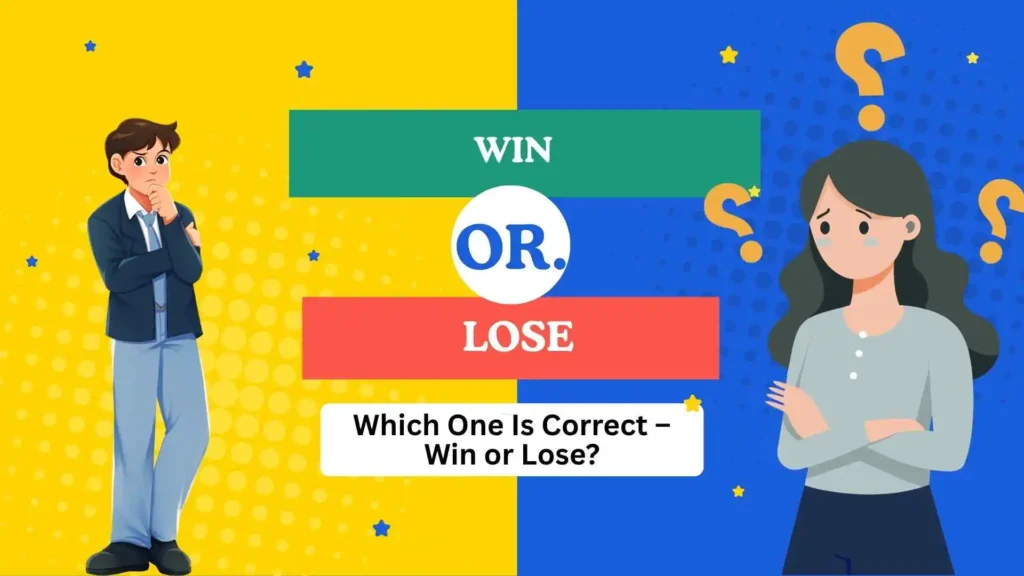
The correct form is win or lose.
Here’s why:
- Lose means “to fail to keep or maintain something” or “not win.”
- Loose means “not tight” or “free,” which has nothing to do with winning or failing.
So, saying “win or loose” is grammatically incorrect and changes the meaning entirely.
Meaning of “Win”
Win is a verb that means to succeed in a contest, achieve victory, or gain something desirable.
In simple words, win is what happens when you are victorious.
Examples:
- I hope our team will win the championship this year.
- She trained hard to win the race.
- No matter what, you can win by staying positive.
- He managed to win the argument with his smart reasoning.
- We all want to win when we play a game.
Meaning of “Lose”
Lose is a verb that means to fail to win, misplace something, or be deprived of something.
It is used whenever someone does not succeed or something is taken away.
Examples:
- Our team might lose if we don’t practice.
- Don’t lose your keys; keep them safe.
- I never want to lose hope in difficult times.
- He will lose the game if he doesn’t focus.
- She didn’t want to lose the opportunity to speak.
Why Do People Confuse Win and Loose?
Many people mistakenly write “win or loose” because of:
- Spelling similarity: “Lose” and “loose” look alike, but they have different meanings.
- Pronunciation: Both words sound similar, especially in casual speech.
- Typing mistakes: Quick typing often leads to the wrong vowel being used.
Understanding the difference helps avoid confusion in writing.
Just Win or Lose – Is It Correct?
Yes, using “win or lose” by itself is correct in almost all contexts.
Common mistakes:
- Saying “win or loose” when referring to victory/failure is wrong.
- Misusing “loose” changes the meaning entirely, as in:
- Wrong: You will win or loose the match.
- Correct: You will win or lose the match.
Easy Trick to Remember the Difference
Here’s a simple tip:
- Lose has one o, and you don’t want to lose one thing. Think of losing as “one thing gone.”
- Loose has two o’s, and it describes something loose or free, like shoes that are not tight.
So, when talking about winning or failing, always pick lose.
Related Phrases with “Win or Lose”
Several phrases use the same concept of winning or failing.
In no case: Never do something, no matter what.
- Example: In no case should you give up, whether you win or lose.
In any case: Regardless of the outcome.
- Example: In any case, we must try our best to win or lose gracefully.
In that case: Referring to a specific situation.
- Example: In that case, if we win or lose, let’s celebrate our effort.
These phrases help add clarity and style to your sentences.
Common Misspellings
| Correct | Incorrect |
| win | winn |
| lose | loose |
| receive | recieve |
| separate | seperate |
| definitely | definately |
| accommodation | accomodation |
| occasion | occassion |
| judgment | judgement |
| necessary | neccessary |
| argument | arguement |
| until | untill |
| beginning | begining |
| embarrass | embarass |
| privilege | privelege |
| restaurant | resturant |
Frequently Asked Questions
Is “win or loose” ever correct?
No. The correct phrase is win or lose. Using loose in this context is always wrong.
Is it one word or two?
It is two words: “win or lose.”
Can I use it in formal writing?
Yes. Win or lose is appropriate in both formal and casual writing.
What does “lose” mean in this phrase?
It means to fail in achieving victory or to be deprived of something.
What does “win” mean in this phrase?
It means to achieve success, victory, or a favorable outcome.
Conclusion
Always remember that the correct form is win or lose. Win represents success, and lose represents failure or missing out. Avoid the common mistake of using loose, which has a completely different meaning. By practicing these tips and examples, you can confidently use win or lose in writing and speech, making your language clear, precise, and professional.

Hi, I’m Robert Hayes, a lifelong word enthusiast and grammar geek. Ever since I can remember, I’ve been fascinated by the way words shape our thoughts and communication. Over the years, I’ve dedicated myself to exploring English grammar in depth, helping readers understand it in simple, practical ways. When I’m not editing or writing, you can find me buried in a classic novel or experimenting with creative writing exercises. My goal is to make grammar approachable, fun, and empowering for everyone. Sharing my knowledge has been a passion, and I love seeing others improve their writing one sentence at a time.
Books by Robert Hayes:
-
Mastering English Grammar: A Practical Guide
-
The Writer’s Toolbox: Grammar and Style Essentials