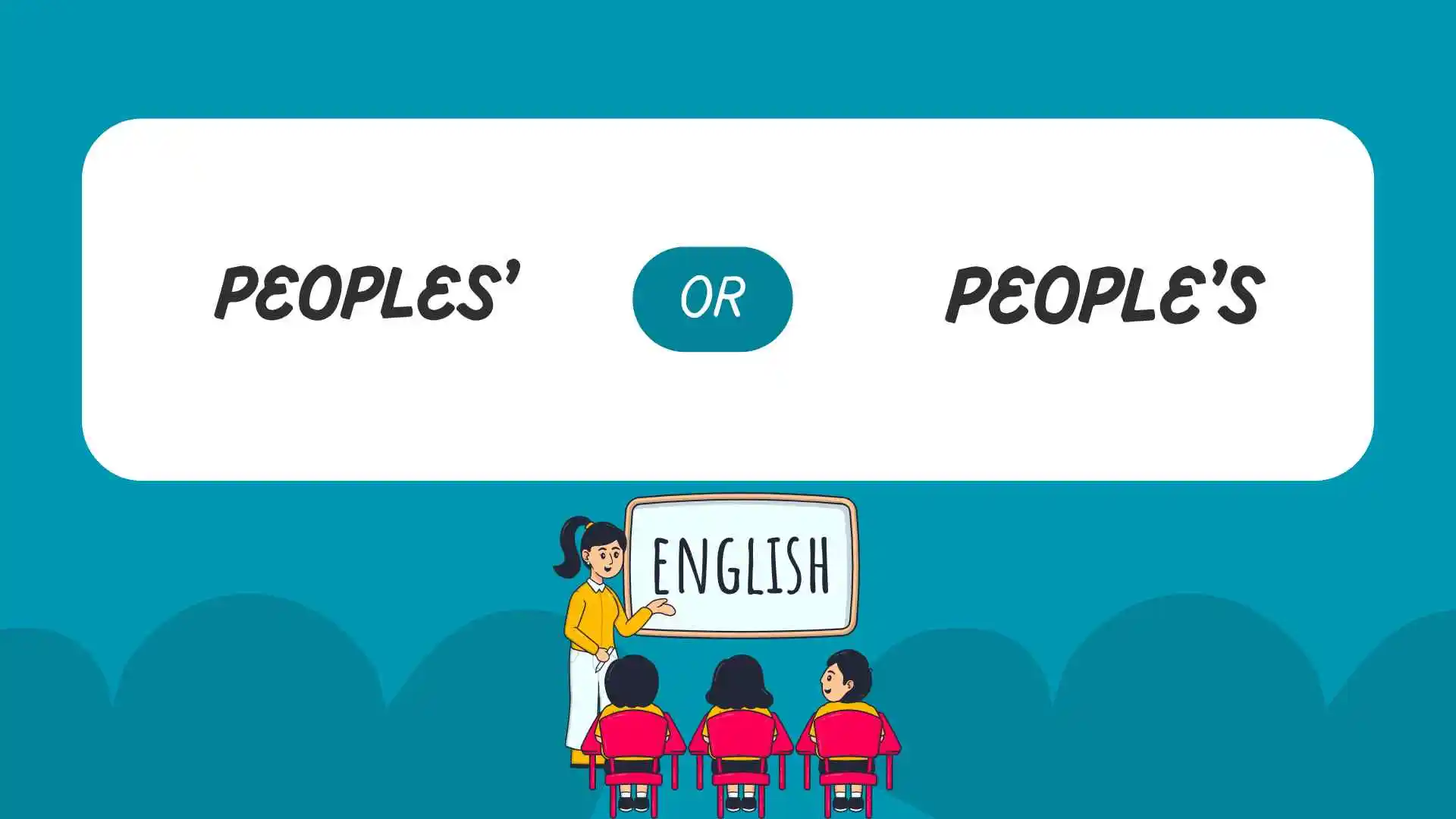
Peoples’ or people’s is a grammar question that confuses many English learners and even native speakers. The correct form depends on meaning, but in most cases, “people’s” is the right choice.
In this article, you will clearly understand the difference between people’s and peoples’, when to use each one, and how to avoid common mistakes. By the end, you will never mix them up again.
Which One Is Correct – Peoples’ or People’s?
The correct and most commonly used form is “people’s”.
“Peoples’” is also correct, but it is rarely used in everyday English.
Here is the simple rule:
- People’s = correct for most situations (singular possessive of “people”)
- Peoples’ = correct only when talking about multiple groups of people (plural nations or ethnic groups)
Why “peoples’” is often wrong in daily use
Most writers mistakenly add an extra “s” because “people” already looks plural.
But in modern English, we usually treat “people” as a plural noun that takes the possessive form people’s, not “peoples’”.
Meaning of “People’s”
People’s is the possessive form of the word “people.”
It means something belongs to a group of people.
Simple explanation
We use “people’s” when talking about things owned, shared, or related to a group of individuals.
Example sentences:
- The people’s voice must be heard in a democracy.
- This is a people’s park built for everyone.
- The people’s opinion matters in elections.
- The festival reflects the people’s culture and traditions.
- The government should respect the people’s rights.
Meaning of “Peoples’”
Peoples’ is the possessive form of “peoples,” which is the plural of “people.”
Simple explanation
We use “peoples’” when talking about more than one group of people, usually different nations, tribes, or ethnic communities.
When it is used
It is mostly used in academic, historical, or cultural writing.
Example sentences:
- The museum displays artifacts from many peoples’ traditions.
- The conference discussed the rights of indigenous peoples’ lands.
- The book explores ancient peoples’ civilizations.
- The festival celebrates different peoples’ cultures.
- The war affected several peoples’ territories.
Why Do People Confuse People’s and Peoples’?
Many learners mix these two forms for a few simple reasons:
1. Spelling similarity
Both words look almost identical. The only difference is the position of the apostrophe.
2. Pronunciation
They sound exactly the same when spoken, so learners rely only on guessing.
3. Grammar confusion
Many people think “people” is always plural, so they wrongly assume “peoples’” is the correct possessive.
4. Lack of exposure
In everyday English, we rarely see “peoples’,” so learners don’t understand its rare usage.
Just Peoples’ or People’s – Is It Correct?
Both forms are grammatically correct, but context decides everything.
Use “people’s” when:
- Talking about general groups
- Referring to society or population
- Writing everyday English
Use “peoples’” when:
- Referring to multiple ethnic groups
- Talking about nations or tribes
- Writing academic or historical content
Common mistake
Many people write “peoples’” in normal sentences like:
❌ The peoples’ opinion matters
✔ The people’s opinion matters
The first one is incorrect in most cases.
Easy Trick to Remember the Difference
Here is a simple memory trick:
👉 If you are talking about one group of humans → use “people’s”
👉 If you are talking about many different groups → use “peoples’”
Another easy tip:
- Think “people = group”
- Think “peoples = groups of groups”
This small trick will help you avoid 90% of mistakes instantly.
Related Phrases with “People’s”
Understanding related phrases helps you use grammar more naturally.
1. In no case
This means something must never happen.
- In no case should the people’s rights be ignored.
- In no case is it acceptable to violate trust.
2. In any case
This means “whatever happens.”
- In any case, the people’s support is important.
- In any case, we must respect public opinion.
3. In that case
This refers to a situation already mentioned.
- If the government listens, in that case, the people’s trust will increase.
- In that case, the people’s decision will matter more.
Common Misspellings
Here are frequently confused grammar forms:
| Correct Word | Incorrect Word |
| people’s | peoples’ |
| it’s | its |
| they’re | their |
| you’re | your |
| who’s | whose |
| affect | effect |
| lose | loose |
| definitely | definately |
| separate | seperate |
| receive | recieve |
| believe | beleive |
| occurred | occured |
| necessary | neccessary |
| privilege | priviledge |
| accommodation | accomodation |
These mistakes are common, but easy to fix with practice.
Why Correct Grammar Like “People’s” Matters
Using correct grammar improves:
- Professional writing quality
- Academic performance
- SEO ranking for blogs
- Clear communication
- Reader trust
Search engines also prefer content that is clear and grammatically correct, which helps your content rank better on Google.
Common Real-Life Usage Examples
Let’s see how “people’s” appears in real contexts:
- The people’s choice award was announced last night.
- This is a people’s movement for justice.
- The people’s reaction was unexpected.
- Leaders must listen to the people’s needs.
- The law protects the people’s freedom.
These examples show how natural and important this form is in English.
People’s in Formal vs Informal Writing
Formal writing
Used in essays, reports, and academic content:
- The people’s rights must be protected by law.
Informal writing
Used in daily conversation or blogging:
- The people’s vote changed everything.
In both cases, “people’s” remains the standard form.
Is “Peoples’” Ever Used in Modern English?
Yes, but rarely.
It is mostly found in:
- History books
- Anthropology studies
- Cultural research
- International law discussions
Example:
- The rights of indigenous peoples’ lands are protected globally.
Outside these areas, it is almost never used.
Quick Summary of the Difference
- People’s = one group of people (most common)
- Peoples’ = multiple groups of people (rare use)
Why “People’s” Is the Default Choice
English has evolved to simplify usage.
Even though “people” is plural, its possessive form is treated as a single unit: people’s.
That’s why:
- We say “people’s rights”
- Not “peoples’ rights” (unless specific groups are mentioned)
Frequently Asked Questions
1. Is “peoples’” ever correct?
Yes, but only when referring to multiple ethnic or national groups.
2. Is it one word or two?
Both are one word forms:
- people’s
- peoples’
3. Can I use “peoples’” in formal writing?
Yes, but only in academic or cultural contexts. Otherwise, avoid it.
4. What does “people’s” mean?
It means something belongs to or is related to a group of people.
5. Which one is more common?
People’s is far more common in everyday English.
Final Conclusion
Understanding the difference between people’s and peoples’ is simple once you know the rule.
In most situations, people’s is the correct and natural choice because it refers to a group of individuals as a single unit.
The form peoples’ is only used in special cases when talking about multiple groups like nations or tribes.
If you remember this simple rule, you will avoid one of the most common English grammar mistakes and improve your writing instantly.