“Dear sir or madam” is one of the most common greetings used in formal writing. However, many people feel confused about whether it is still correct, professional, or outdated.
The short answer is yes “Dear Sir or Madam” is grammatically correct. Still, it is not always the best choice in modern communication.
In this guide, you will learn the correct meaning, proper usage, common mistakes, examples, memory tricks, and better alternatives. You will also discover when to use it in emails, cover letters, and business communication.
Which One Is Correct – Dear Sir or Madam or Dear Sir Madam?
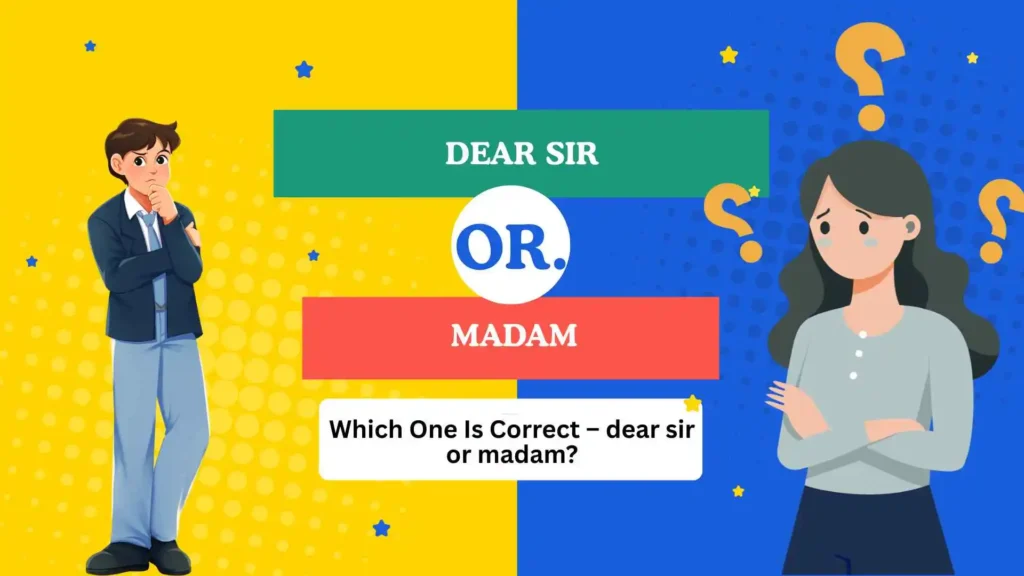
The correct form is “Dear Sir or Madam.”
✅ Correct: Dear Sir or Madam
❌ Incorrect: Dear Sir Madam
The phrase needs the word “or” because you are addressing either a man or a woman when you do not know the recipient’s name.
Without “or,” the sentence becomes grammatically incomplete and awkward.
Why Is “Dear Sir or Madam” Correct?
The phrase works as a polite formal greeting. It means:
“I do not know your name, but I respectfully address whoever receives this message.”
It is commonly used in:
- Formal letters
- Job applications
- Complaint emails
- Business communication
- Official requests
However, modern business writing often prefers personalized greetings whenever possible.
Meaning of “Dear Sir or Madam”
Definition
“Dear Sir or Madam” is a formal salutation used when the writer does not know the recipient’s name or gender.
Simple Explanation
People use this phrase to begin a professional letter politely when they cannot identify the exact person receiving it.
It shows respect and professionalism.
Example Sentences
- Dear Sir or Madam, I am writing to inquire about your services.
- Dear Sir or Madam, please find my attached resume.
- Dear Sir or Madam, I would like to request additional information.
- Dear Sir or Madam, thank you for your time and consideration.
- Dear Sir or Madam, I recently purchased your product and need support.
Meaning of “Sir” and “Madam”
Since the phrase includes two formal titles, it helps to understand each word separately.
Meaning of “Sir”
Sir is a respectful term used to address a man politely.
It is common in:
- Business communication
- Customer service
- Schools
- Formal conversations
Example Sentences with “Sir”
- Excuse me, sir, you dropped your wallet.
- Thank you for your help, sir.
- Good morning, sir.
- May I assist you, sir?
- The manager said, “Please come in, sir.”
Meaning of “Madam”
Madam is a polite and formal way to address a woman.
It is commonly used in professional or respectful settings.
Example Sentences with “Madam”
- Good afternoon, madam.
- Thank you for your patience, madam.
- May I help you, madam?
- The receptionist greeted the guest politely: “Welcome, madam.”
- Please sign here, madam.
Why Do People Confuse Dear Sir or Madam?
Many people make mistakes with this phrase because it sounds old-fashioned and formal. Also, several spelling and grammar issues cause confusion.
1. Spelling Similarity
People sometimes accidentally remove “or” and write:
- Dear Sir Madam
- Dear Sir/Madam
- Dear Sir and Madam
These versions may look similar but are not equally correct in formal grammar.
2. Pronunciation Problems
When spoken quickly, “Sir or Madam” can sound merged together. This causes typing mistakes when writing emails or letters.
3. Common Typing Errors
Fast typing often leads to:
- Missing “or”
- Wrong capitalization
- Missing commas
- Incorrect punctuation
For example:
❌ dear sir or madam
❌ Dear Sir or madame
❌ Dear Sir & Madam
4. Changing Business Writing Trends
Modern communication now encourages using the recipient’s actual name whenever possible.
Because of this, many writers are unsure whether “Dear Sir or Madam” is still acceptable.
The truth is:
- It is still grammatically correct.
- It is just less personal than modern alternatives.
Just Dear Sir or Madam – Is It Correct?
Yes, “Dear Sir or Madam” by itself is completely correct as an opening greeting.
However, people sometimes wonder whether they should add punctuation after it.
Correct Punctuation Styles
British English
- Dear Sir or Madam,
American English
- Dear Sir or Madam:
Both styles are accepted depending on the writing format.
Is “Dear Sir/Madam” Correct?
Yes, many people use “Dear Sir/Madam” in emails and forms.
However, it looks less natural and slightly less polished than writing the full phrase.
Formal writing experts usually recommend:
✅ Dear Sir or Madam
⚠️ Dear Sir/Madam
Is “To Whom It May Concern” Better?
Sometimes.
Both phrases are formal, but they serve different purposes.
Use “Dear Sir or Madam” When:
- Writing to a company
- Contacting a department
- Sending a formal request
Use “To Whom It May Concern” When:
- The recipient is completely unknown
- Writing recommendation letters
- Creating official documents
Easy Trick to Remember the Difference
Here is a simple memory trick:
Think of Choice = “Or”
You are speaking to:
- a Sir
or - a Madam
That is why the word “or” must stay in the phrase.
Without “or,” the sentence loses its meaning.
Quick Memory Formula
One person = “Sir or Madam”
Not:
Sir Madam
This tiny trick helps many writers avoid mistakes instantly.
Related Phrases with “Case”
Many English learners confuse similar formal expressions. Here are three important phrases you should know.
In No Case
Meaning
“In no case” means something should never happen under any condition.
Examples
- In no case should you share your password.
- In no case may employees enter this area without permission.
- In no case will the company refund damaged products without proof.
In Any Case
Meaning
“In any case” means regardless of the situation or outcome.
Examples
- In any case, we must finish the project today.
- She may arrive late, but in any case, the meeting will begin on time.
- In any case, thank you for your support.
In That Case
Meaning
“In that case” refers to a specific situation already mentioned.
Examples
- If the office is closed, in that case, we will return tomorrow.
- In that case, please send the documents by email.
- If you agree, then in that case, we can continue.
Better Alternatives to Dear Sir or Madam
Modern professional writing often prefers more personal greetings.
Here are better alternatives when possible.
If You Know the Name
Use:
- Dear Mr. Ahmed
- Dear Ms. Khan
- Dear Dr. Ali
This sounds more professional and personal.
If You Know the Department
Use:
- Dear Hiring Manager
- Dear Customer Support Team
- Dear Admissions Office
- Dear Sales Department
These options feel modern and direct.
If the Audience Is General
Use:
- Greetings
- Hello
- Good Morning
- Good Afternoon
These work well in less formal emails.
When Should You Use Dear Sir or Madam?
Although it sounds traditional, the phrase still has useful purposes.
Use It When:
- You do not know the recipient’s name.
- You are writing a formal complaint.
- You are contacting a company officially.
- You are submitting legal or business documents.
- You are writing a professional inquiry.
Avoid It When:
- The recipient’s name is available.
- You are sending casual emails.
- The workplace culture is informal.
- You can use a department name instead.
Examples of Dear Sir or Madam in Real Writing
Job Application Example
Dear Sir or Madam,
I am applying for the marketing position advertised on your website.
Complaint Letter Example
Dear Sir or Madam,
I would like to report an issue with my recent purchase.
Information Request Example
Dear Sir or Madam,
Could you please provide details about your training program?
Business Inquiry Example
Dear Sir or Madam,
I am interested in learning more about your services.
Common Mistakes People Make
Here are frequent errors writers should avoid.
Wrong Capitalization
❌ dear sir or madam
✅ Dear Sir or Madam
Missing “Or”
❌ Dear Sir Madam
✅ Dear Sir or Madam
Wrong Spelling
❌ Dear Sir or Madame
✅ Dear Sir or Madam
Informal Usage
Using this phrase in casual texting sounds unnatural.
Example:
❌ Dear Sir or Madam, what’s up?
Common Misspellings
| Correct | Incorrect |
| Dear Sir or Madam | Dear Sir Madam |
| Accommodation | Acommodation |
| Separate | Seperate |
| Receive | Recieve |
| Definitely | Definately |
| Business | Buisness |
| Necessary | Neccessary |
| Government | Goverment |
| Occasion | Ocassion |
| Recommend | Reccomend |
| Successful | Succesful |
| Environment | Enviroment |
| Address | Adress |
| Grammar | Grammer |
| Writing | Writting |
Formal Writing Tips for Better Professional Emails
If you use “Dear Sir or Madam,” follow these best practices.
Keep the Tone Professional
Avoid slang or overly casual language.
Use Short Sentences
Simple writing improves readability and professionalism.
Add a Clear Subject
Always explain the purpose of your message quickly.
End Politely
Use professional closings like:
- Sincerely
- Best regards
- Kind regards
Is Dear Sir or Madam Outdated?
Some experts consider it slightly old-fashioned, but it is not wrong.
Today, businesses prefer personalized communication because it feels warmer and more engaging.
Still, “Dear Sir or Madam” remains acceptable in:
- Government communication
- Legal documents
- Traditional business letters
- Formal applications
So, it is still useful when you genuinely do not know the recipient.
Frequently Asked Questions
Is Dear Sir or Madam ever incorrect?
Yes, it can feel too generic if you already know the recipient’s name. In that case, use their actual name instead.
Is it one word or two?
“Sir” and “Madam” are separate words. The full phrase is:
Dear Sir or Madam
Can I use Dear Sir or Madam in emails?
Yes. It is still acceptable in professional emails, especially when the recipient is unknown.
Is Dear Sir/Madam also correct?
Yes, but it is less formal and slightly less polished than writing the full phrase.
What does Dear Sir or Madam mean?
It is a respectful greeting used in formal writing when the writer does not know who will receive the message.
Should I capitalize Sir and Madam?
Yes. In formal greetings, both words should be capitalized.
Correct form:
Dear Sir or Madam
Conclusion
Dear Sir or Madam is the correct and grammatically proper form. The phrase is still widely accepted in formal writing, especially when the recipient’s name is unknown.
Remember these key points:
- Always include the word “or.”
- Capitalize both Sir and Madam.
- Use the phrase mainly in professional or formal situations.
- Prefer personalized greetings whenever possible.
By understanding the meaning and proper usage, you can write clearer, more professional emails and letters with confidence.

Hi, I’m Robert Hayes, a lifelong word enthusiast and grammar geek. Ever since I can remember, I’ve been fascinated by the way words shape our thoughts and communication. Over the years, I’ve dedicated myself to exploring English grammar in depth, helping readers understand it in simple, practical ways. When I’m not editing or writing, you can find me buried in a classic novel or experimenting with creative writing exercises. My goal is to make grammar approachable, fun, and empowering for everyone. Sharing my knowledge has been a passion, and I love seeing others improve their writing one sentence at a time.
Books by Robert Hayes:
-
Mastering English Grammar: A Practical Guide
-
The Writer’s Toolbox: Grammar and Style Essentials