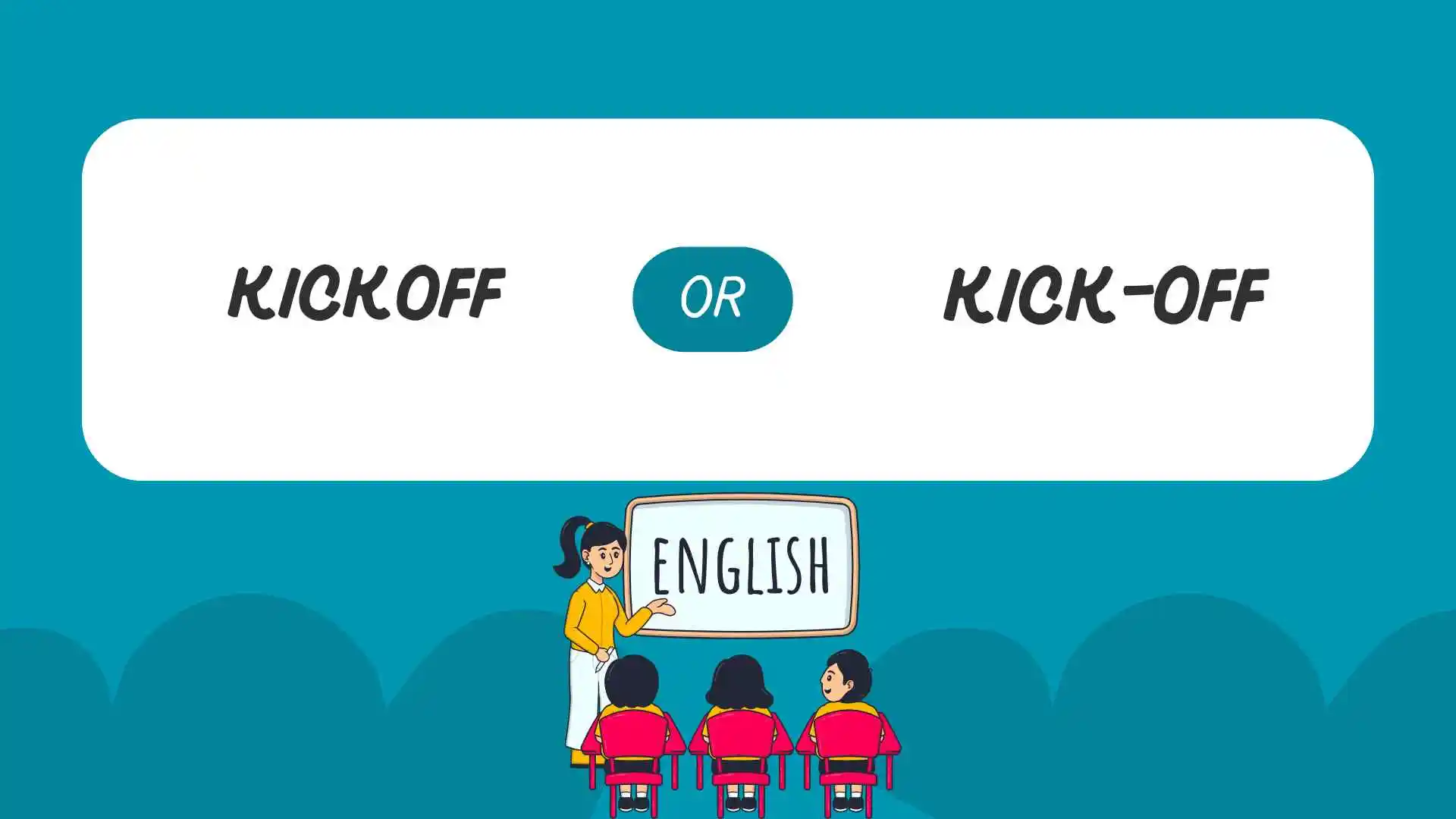
Kickoff or kick-off is a common grammar question that confuses many English learners and writers.
Both forms are actually correct, but they are used in different ways. That is why people often mix them up in emails, sports articles, blog posts, and everyday writing.
In this guide, you will learn the difference between kickoff and kick-off, when to use each one, common mistakes to avoid, easy memory tricks, examples, FAQs, and more.
Which One Is Correct – Kickoff or Kick-Off?
The short answer is: both can be correct, depending on how they are used.
- Kickoff is the modern one-word form.
- Kick-off is the older hyphenated form.
Today, most style guides and modern writers prefer kickoff as one word, especially in American English.
Correct Usage:
- Kickoff → commonly used as a noun or adjective
- Kick-off → older alternative spelling, still seen sometimes
Examples:
- The football kickoff starts at 7 PM.
- We had a project kickoff meeting today.
- The company held a kick-off event for the new campaign.
While both appear in writing, kickoff is now more popular and widely accepted.
Meaning of “Kickoff”
The word kickoff usually refers to the start or beginning of something.
It originally came from sports, especially football, where the game begins with a kickoff.
Today, people also use it in business, school, marketing, and events.
Simple Definition
Kickoff means:
- The beginning of an event
- The start of a game
- The launch of a project or activity
Example Sentences
- The kickoff for the tournament begins tonight.
- We attended the project kickoff meeting yesterday.
- The marketing kickoff event was successful.
- Fans arrived early for the game kickoff.
- The company planned a kickoff celebration for the new product.
Common Uses of “Kickoff”
People often use kickoff in:
- Sports
- Business meetings
- Team projects
- Marketing campaigns
- School programs
Meaning of “Kick-Off”
The term kick-off has the same meaning as kickoff.
The only difference is the hyphen.
This spelling was more common in older English writing and is still used by some newspapers, websites, and British publications.
When Is “Kick-Off” Used?
You may still see kick-off in:
- British English
- Sports journalism
- Formal publications
- Older grammar styles
Example Sentences
- The kick-off match attracted thousands of fans.
- Our team attended the project kick-off session.
- The campaign kick-off was held on Monday.
- The coach discussed strategy before kick-off.
- The event kick-off started late because of rain.
Is “Kick-Off” Wrong?
No, it is not wrong.
However, kickoff without the hyphen is now more common in modern writing.
Why Do People Confuse Kickoff and Kick-Off?
Many people struggle with these words because they look and sound almost the same.
Here are the main reasons for the confusion.
1. Similar Pronunciation
Both words sound identical when spoken.
You cannot hear the hyphen, so writers often guess the spelling.
2. Changing Language Rules
English changes over time.
Many hyphenated words eventually become one word.
For example:
- E-mail → email
- On-line → online
- Kick-off → kickoff
3. Different Style Guides
Some writing styles still prefer hyphenated forms.
Others use the modern version.
This creates inconsistency online.
4. Sports vs Business Usage
Sports writers may use “kick-off,” while business writers often use “kickoff.”
People copy whichever version they see most.
5. Typing Habits
Some writers automatically add hyphens without checking grammar rules.
That leads to spelling mistakes.
Just Kickoff – Is It Correct?
Yes, just kickoff can be correct depending on the sentence.
However, context matters.
Correct Examples
- The kickoff starts at noon.
- We planned a kickoff meeting.
Incorrect Examples
- ❌ We will kickoff the event tomorrow.
In that sentence, “kick off” should be two words because it is acting as a verb.
Correct Verb Form
- ✅ We will kick off the event tomorrow.
This is one of the most important grammar points to remember.
Quick Rule
- Kickoff = noun/adjective
- Kick off = verb phrase
Easy Trick to Remember the Difference
Here is a simple memory trick.
Use This Rule:
- If it names a thing or event → use kickoff
- If it shows an action → use kick off
Examples
Noun
- The kickoff meeting was helpful.
Verb
- We will kick off the meeting at 9 AM.
Easy Memory Tip
Think of it this way:
Things stay together. Actions split apart.
So:
- Event = kickoff
- Action = kick off
This trick helps many writers avoid mistakes instantly.
Related Phrases with “Kickoff”
Many phrases use the idea of a beginning or starting point.
Here are some common related expressions.
Project Kickoff
This means the official start of a project.
Example:
- The team held a project kickoff on Monday.
Kickoff Meeting
A first meeting before work begins.
Example:
- We scheduled a kickoff meeting with the client.
Season Kickoff
The beginning of a sports season.
Example:
- Fans are excited for the season kickoff.
Campaign Kickoff
The launch of a marketing or political campaign.
Example:
- The campaign kickoff attracted many supporters.
Kick Off
Used as a verb phrase.
Example:
- The speaker will kick off the event.
Common Misspellings
Below are common spelling mistakes people make with grammar-related words.
| Correct | Incorrect |
| kickoff | kick-offf |
| kickoff | kickof |
| kick off | kickoffed |
| definitely | definately |
| separate | seperete |
| receive | recieve |
| grammar | grammer |
| business | buisness |
| calendar | calender |
| writing | writting |
| beginning | begining |
| occurrence | occurence |
| successful | succesful |
| tomorrow | tommorow |
| argument | arguement |
Kickoff vs Kick Off – Important Grammar Rule
This is the grammar rule most people need to know.
Use “Kickoff” as a Noun
A noun names a thing, event, or idea.
Examples
- The kickoff begins at 6 PM.
- We attended the kickoff meeting.
Use “Kick Off” as a Verb
A verb shows action.
Examples
- They will kick off the event tonight.
- The coach kicked off practice early.
This rule is very important in formal writing.
Is Kickoff One Word or Two?
This depends on how it is used.
One Word: Kickoff
Use it as a noun or adjective.
Examples
- kickoff event
- kickoff party
- kickoff strategy
Two Words: Kick Off
Use it as a verb phrase.
Examples
- kick off the meeting
- kick off the season
- kick off discussions
Examples of Kickoff in Everyday Writing
Here are practical examples from daily life.
Sports
- The game kickoff was delayed because of rain.
Business
- Our kickoff meeting lasted two hours.
School
- Students attended the science fair kickoff.
Marketing
- The brand planned a social media kickoff campaign.
Events
- The wedding celebration kickoff started with music.
Why “Kickoff” Became More Popular
Modern English prefers shorter and cleaner spellings.
That is why many hyphenated words lose the hyphen over time.
Examples
| Old Form | Modern Form |
| on-line | online |
| co-worker | coworker |
| kick-off | kickoff |
Digital writing and search engines also influence spelling trends.
People now search for “kickoff” more often than “kick-off.”
Formal vs Informal Usage
Formal Writing
In professional writing, many companies prefer:
- kickoff meeting
- kickoff event
Informal Writing
Both forms may appear casually online.
Still, using kickoff looks more modern and polished.
British English vs American English
There can also be regional differences.
American English
Usually prefers:
- kickoff
British English
Sometimes still uses:
- kick-off
Neither is completely wrong.
The important thing is consistency.
Frequently Asked Questions
Is kick-off ever correct?
Yes, kick-off is correct and still used in some publications, especially in British English.
However, kickoff is more common in modern American English.
Is kickoff one word or two?
As a noun, it is usually one word: kickoff.
As a verb, it becomes two words: kick off.
Can I use kickoff in formal writing?
Yes, absolutely.
Many businesses and organizations use terms like:
- kickoff meeting
- project kickoff
- kickoff presentation
What does kickoff mean?
Kickoff means the beginning or start of something.
It can refer to sports, meetings, projects, campaigns, or events.
Which spelling is more modern?
The one-word spelling kickoff is considered more modern today.
Many websites and companies now prefer it.
Is “kick off” different from “kickoff”?
Yes.
- Kick off = action (verb)
- Kickoff = thing/event (noun)
This is the key grammar difference.
Common Grammar Mistakes with Kickoff
People often make small grammar mistakes with this word.
Incorrect:
- ❌ We kickoff the event tomorrow.
Correct:
- ✅ We kick off the event tomorrow.
Another common mistake:
Incorrect:
- ❌ The kick off meeting starts now.
Correct:
- ✅ The kickoff meeting starts now.
Learning the noun vs verb rule solves most errors.
SEO and Business Usage of Kickoff
The word kickoff is very common in:
- project management
- digital marketing
- sports content
- corporate communication
Businesses often use terms like:
- kickoff presentation
- kickoff strategy
- kickoff agenda
- kickoff session
These phrases sound professional and organized.
Conclusion
The confusion between kickoff and kick-off is very common, but the rule is actually simple.
Use kickoff as a noun or adjective when talking about the start of something.
Use kick off as a verb when describing an action.
Although kick-off still appears in some writing, the one-word form kickoff is more modern and widely used today.
Once you remember the “thing vs action” rule, choosing the correct spelling becomes much easier.

Olivia Brown
Hi, I’m Olivia Brown, a passionate writer and grammar enthusiast who loves helping people master the art of language. Ever since I was a child, words have fascinated me, and I find joy in exploring the rules and nuances of English. Through my writing, I aim to make grammar simple, fun, and accessible for everyone. I enjoy sharing tips, tricks, and creative exercises that help learners feel confident in their writing. When I’m not writing, you’ll find me reading, traveling, or experimenting with new ways to teach language. Grammar isn’t just my profession—it’s my passion, and I love inspiring others to love it too.
Books:
-
Grammar Made Easy
-
Mastering English Rules