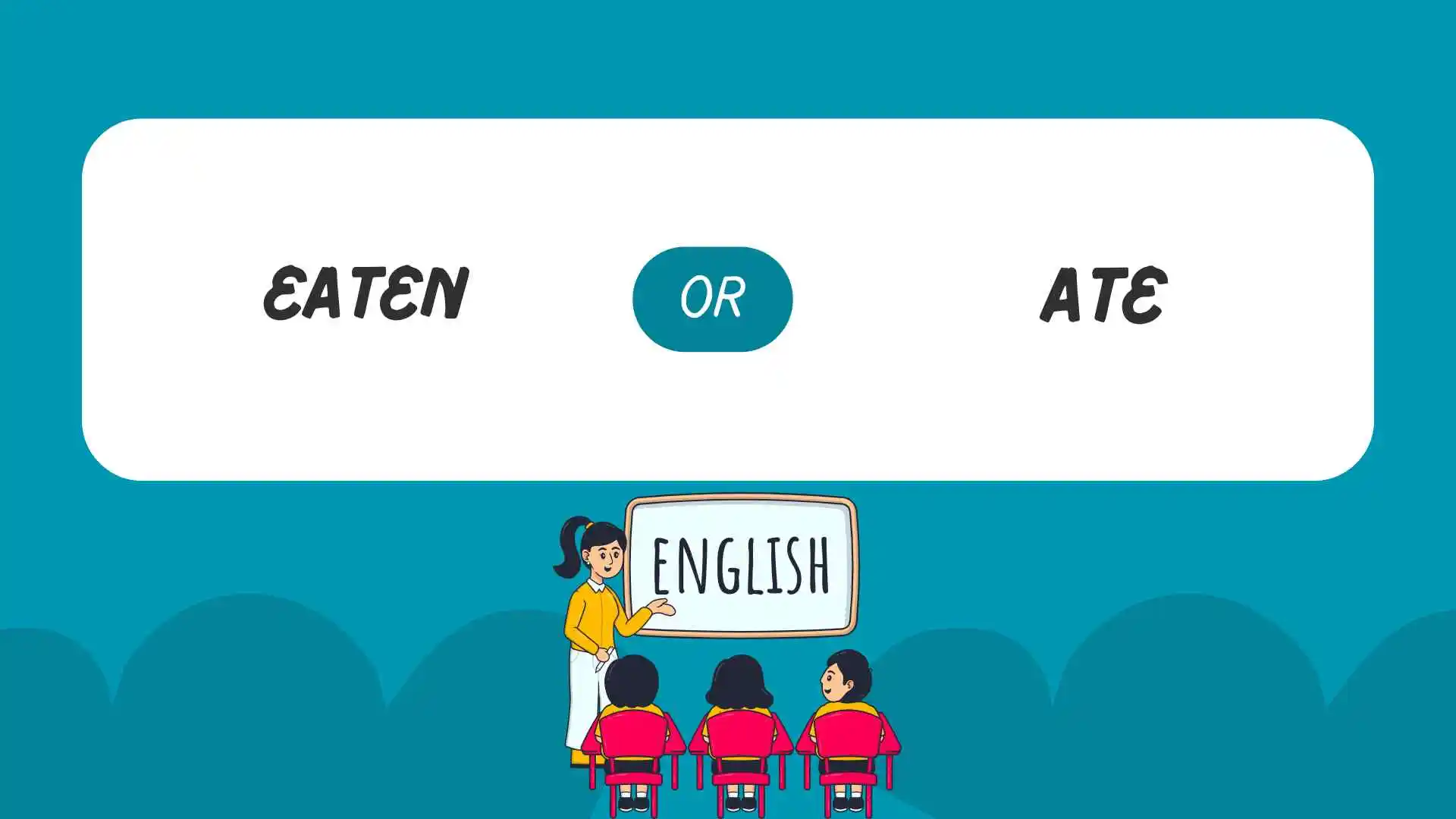
Eaten or ate is a common grammar question that confuses many English learners and even native speakers. Both words come from the verb “eat,” but they are used in different ways.
The short answer is simple: “ate” is the past tense, while “eaten” is the past participle used with helping verbs.
In this guide, you will learn the meaning of both words, how to use them correctly, common mistakes to avoid, and easy tricks to remember the difference forever.
Which One Is Correct – Eaten or Ate?
Both words are correct, but they are used in different grammar situations.
- Ate = simple past tense
- Eaten = past participle
Use “ate” when talking about something that already happened.
Example:
- I ate dinner at 8 PM.
Use “eaten” with helping verbs like:
- has
- have
- had
- was
- were
Example:
- I have eaten dinner already.
Incorrect Example
❌ I have ate dinner.
✅ I have eaten dinner.
This is one of the most common English grammar mistakes.
Meaning of “Ate”
The word ate is the simple past form of the verb “eat.”
It describes an action that happened in the past and is already finished.
Simple Definition
“Ate” means someone consumed food earlier.
Example Sentences
- I ate pizza last night.
- She ate breakfast before school.
- They ate at a new restaurant yesterday.
- We ate too much during the party.
- He ate an apple after the workout.
When to Use “Ate”
Use “ate” when:
- The action is completed
- The sentence talks about the past
- No helping verb is used
Meaning of “Eaten”
The word eaten is the past participle form of “eat.”
It cannot usually stand alone in a sentence.
Instead, it works with helping verbs like:
- have
- has
- had
- was
- were
- being
Simple Definition
“Eaten” describes food that has already been consumed.
Example Sentences
- I have eaten lunch already.
- She has eaten all the cookies.
- They had eaten before arriving.
- The cake was eaten quickly.
- We have never eaten sushi before.
When to Use “Eaten”
Use “eaten”:
- With helping verbs
- In perfect tenses
- In passive voice sentences
Difference Between Ate and Eaten
Many people mix these words up because both relate to the verb “eat.”
However, their grammar roles are different.
| Word | Grammar Form | Example |
| Ate | Simple Past | I ate dinner. |
| Eaten | Past Participle | I have eaten dinner. |
Quick Rule
- No helping verb → use ate
- Helping verb present → use eaten
Why Do People Confuse Ate and Eaten?
There are several reasons why these words create confusion.
1. Both Come From the Same Verb
Since both words belong to the verb “eat,” many learners think they can replace each other.
However, English grammar rules separate their usage.
2. Pronunciation Similarity
“Ate” and “eaten” sound connected, especially during fast speech.
Because of this, people often type or say the wrong form.
3. Grammar Tense Confusion
Past tense and past participles can be difficult to understand.
For example:
- I ate
- I have eaten
Both talk about the past, but the sentence structure changes the correct word.
4. Common Typing Mistakes
People often write:
❌ I have ate
✅ I have eaten
This mistake appears often on social media and in casual writing.
Just Ate or Just Eaten – Is It Correct?
This is another very common grammar question.
“Just Ate”
“Just ate” is correct in informal conversation.
Example:
- I just ate lunch.
This means the action happened recently.
“Just Eaten”
“Just eaten” usually needs a helping verb.
Correct examples:
- I have just eaten lunch.
- She has just eaten dinner.
Incorrect Usage
❌ I just eaten lunch.
✅ I just ate lunch.
✅ I have just eaten lunch.
Easy Trick to Remember the Difference
Here is a simple memory tip that works well.
Remember This Rule
- Ate works alone
- Eaten needs a helper
Think of “eaten” as a word that cannot travel by itself.
It always needs helping verbs like:
- have
- has
- had
Easy Examples
- I ate dinner.
- I have eaten dinner.
If you see a helping verb, “eaten” is usually the correct choice.
Grammar Breakdown of Eat, Ate, and Eaten
Understanding all forms of the verb makes things easier.
| Verb Form | Word |
| Base Verb | Eat |
| Past Tense | Ate |
| Past Participle | Eaten |
Examples
- Present: I eat healthy food.
- Past: I ate healthy food.
- Perfect Tense: I have eaten healthy food.
This pattern is important in English grammar.
Common Sentences Using Ate
Here are more examples using “ate.”
- The baby ate all the cereal.
- We ate dinner together.
- He ate too quickly.
- I ate before the movie started.
- They ate at a famous hotel.
- She ate ice cream after lunch.
- My friends ate burgers yesterday.
- The dog ate my homework.
These examples show simple past actions.
Common Sentences Using Eaten
Now look at sentences using “eaten.”
- I have eaten enough food today.
- She has eaten here before.
- We had eaten when they arrived.
- The sandwiches were eaten quickly.
- He has never eaten seafood.
- The meal had already been eaten.
- They have eaten too much sugar.
- The cookies were eaten by the children.
These examples include helping verbs.
Related Phrases with “Eat”
Many English phrases use the verb “eat.”
Here are some common ones.
Eat Out
Meaning: to eat at a restaurant
Example:
- We love to eat out on weekends.
Eat Up
Meaning: finish all food
Example:
- Please eat up your vegetables.
Eat In
Meaning: eat at home
Example:
- Tonight we will eat in.
Eat Away
Meaning: slowly destroy
Example:
- Rust can eat away metal.
Eat Like a Horse
Meaning: eat a lot
Example:
- After football practice, he ate like a horse.
Common Grammar Rules for Ate and Eaten
Learning these rules can improve your English writing fast.
Rule 1: Simple Past = Ate
Example:
- I ate breakfast early.
Rule 2: Perfect Tense = Eaten
Example:
- I have eaten breakfast already.
Rule 3: Passive Voice Uses Eaten
Example:
- The cake was eaten by the kids.
Rule 4: Never Use “Have Ate”
Incorrect:
- I have ate lunch.
Correct:
- I have eaten lunch.
Common Misspellings and Grammar Mistakes
Here are common grammar mistakes people make with “ate” and “eaten.”
| Correct | Incorrect |
| eaten | ateen |
| ate | et |
| have eaten | have ate |
| had eaten | had ate |
| has eaten | has ate |
| eaten already | ate already (in perfect tense) |
| I ate | I eaten |
| was eaten | was ate |
| were eaten | were ate |
| eaten food | ate fooded |
| they ate | they eaten |
| she has eaten | she have ate |
| we had eaten | we had ate |
| eaten quickly | ate quicklyed |
| he ate lunch | he eaten lunch |
These mistakes are common in informal writing and among English learners.
Why Proper Grammar Matters
Using correct grammar improves communication.
It also helps in:
- School assignments
- Job applications
- Emails
- Social media posts
- Professional writing
Wrong grammar can confuse readers and make writing look less trustworthy.
That is why understanding “ate” and “eaten” matters.
Ate vs Eaten in American and British English
The rules are the same in both American and British English.
Examples:
- American English: I have eaten breakfast.
- British English: I have eaten breakfast.
Both forms follow the same grammar structure worldwide.
How Teachers Explain Ate and Eaten
Teachers often use timeline examples.
Ate = Finished Action
Example:
- Yesterday I ate pasta.
The action is completely finished.
Eaten = Connected to Another Verb
Example:
- I have eaten pasta before.
The helping verb changes the sentence structure.
This method helps students understand tense usage faster.
Examples in Everyday Conversation
Using Ate
- What did you eat?
- I ate chicken and rice.
Using Eaten
- Have you eaten yet?
- Yes, I have eaten already.
You will hear these forms often in daily English conversations.
Frequently Asked Questions
Is “have ate” ever correct?
No, “have ate” is grammatically incorrect.
The correct phrase is “have eaten.”
Can “eaten” be used alone?
Usually no.
“Eaten” normally needs a helping verb like “has,” “have,” or “had.”
Is “ate” present tense?
No.
“Ate” is the simple past tense of “eat.”
Which is more formal: ate or eaten?
Neither word is more formal.
They simply serve different grammar purposes.
Can I say “I just eaten”?
No.
Correct forms are:
- I just ate
- I have just eaten
Why is English grammar confusing sometimes?
English has irregular verbs that change differently from normal verbs.
“Eat,” “ate,” and “eaten” are examples of irregular verb forms.
Final Thoughts on Eaten or Ate
The difference between eaten and ate becomes easy once you understand verb tenses.
Use ate for simple past actions without helping verbs.
Use eaten with helping verbs like “have,” “has,” and “had.”
Remember this simple rule:
- Ate works alone
- Eaten needs help
With practice, you will use both words naturally and confidently in speaking and writing.

Olivia Brown
Hi, I’m Olivia Brown, a passionate writer and grammar enthusiast who loves helping people master the art of language. Ever since I was a child, words have fascinated me, and I find joy in exploring the rules and nuances of English. Through my writing, I aim to make grammar simple, fun, and accessible for everyone. I enjoy sharing tips, tricks, and creative exercises that help learners feel confident in their writing. When I’m not writing, you’ll find me reading, traveling, or experimenting with new ways to teach language. Grammar isn’t just my profession—it’s my passion, and I love inspiring others to love it too.
Books:
-
Grammar Made Easy
-
Mastering English Rules