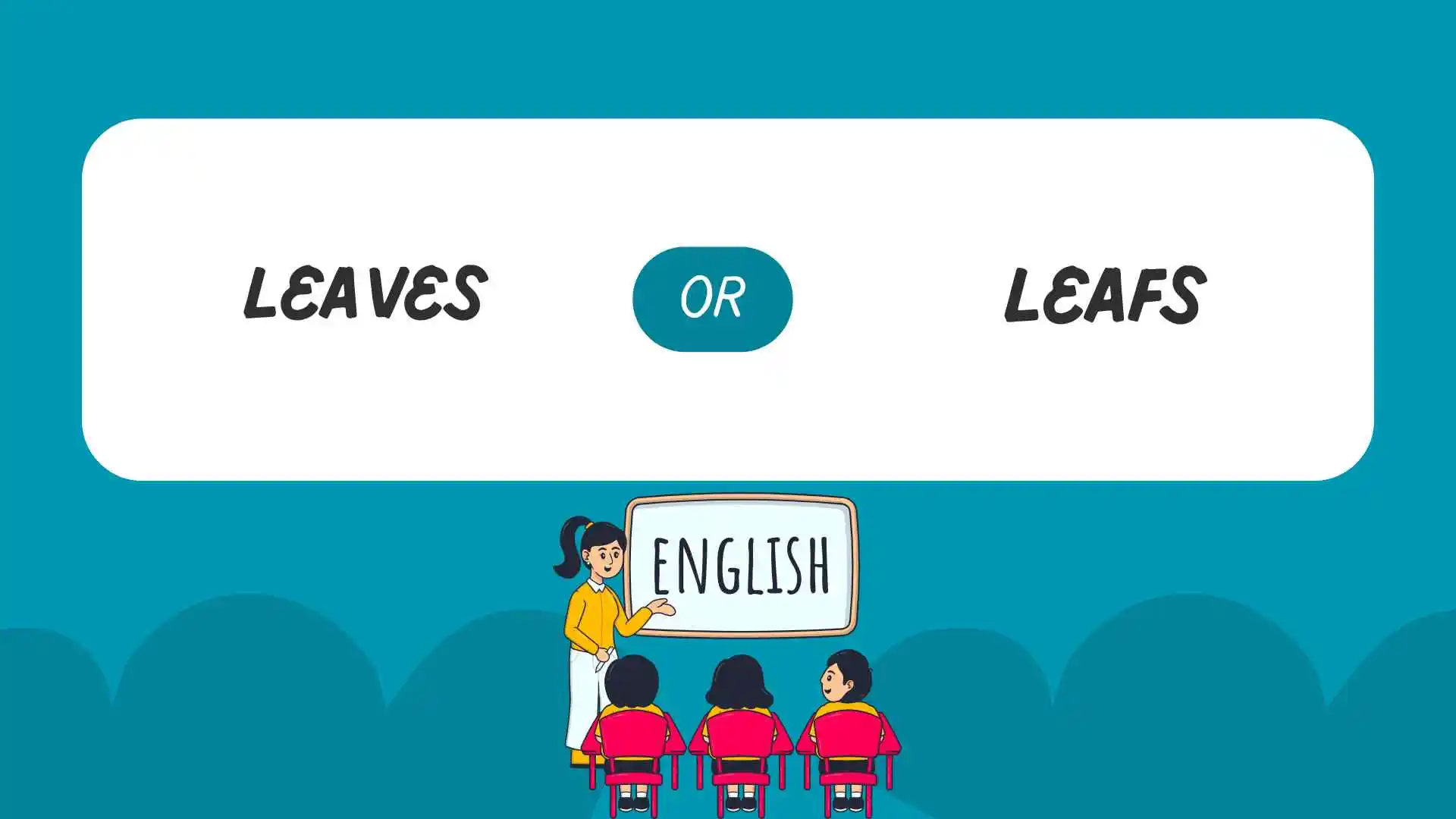
Leaves or leafs which one is correct? If you have ever typed “leafs” and wondered whether it was wrong, you are not alone.
The correct plural form of “leaf” is usually leaves. However, there are a few special cases where “leafs” is also used.
In this article, you will learn the difference between leaves and leafs, their meanings, examples, common mistakes, memory tricks, and how to use the correct form confidently in everyday English.
Which One Is Correct – Leaves or Leafs?
The correct plural form of leaf is leaves in most situations.
✅ Correct: Leaves
❌ Usually Incorrect: Leafs
English changes some words ending in -f into -ves when making them plural.
For example:
- Leaf → Leaves
- Wolf → Wolves
- Knife → Knives
So, if you are talking about the green parts of a tree or pages in a book, the correct word is leaves.
However, leafs is not always wrong. It can be correct in special uses, especially as a verb or in proper names like the hockey team Toronto Maple Leafs.
Meaning of “Leaves”
The word leaves is the most common plural form of “leaf.”
A leaf is the flat green part of a plant or tree that helps it grow through sunlight.
The word “leaves” can also mean:
- Pages of a book
- Thin layers of material
- The verb “leave” in third person form
Simple Definition
Leaves means more than one leaf.
Example Sentences
- The tree loses its leaves in autumn.
- Yellow leaves covered the ground.
- She pressed dry leaves into her notebook.
- The wind blew the leaves across the road.
- He leaves work at 5 PM every day.
Meaning of “Leafs”
The word leafs is much less common.
It is mainly used as:
- A verb form of “leaf”
- A proper noun in names
- An informal or mistaken plural spelling
When “Leafs” Is Used
As a verb, “leafs” means to turn pages quickly.
Example Sentences
- She leafs through magazines while waiting.
- He leafs through the newspaper every morning.
- The student leafs through her notes before the test.
- My brother leafs through comic books at the store.
- The librarian leafs through the old records carefully.
Important Note
If you mean more than one plant leaf, always use leaves, not leafs.
Why Do People Confuse Leaves and Leafs?
Many English learners mix up these words because English spelling rules can be tricky.
Here are the main reasons for confusion.
Spelling Similarity
Both words come from the base word “leaf,” so people naturally think adding “s” should make it plural.
Pronunciation Confusion
“Leaves” sounds different from “leaf,” which surprises many learners.
Common Typing Mistakes
People often type quickly and write “leafs” automatically because many English plurals simply add “s.”
English Grammar Exceptions
English has many irregular plural nouns, such as:
- Man → Men
- Child → Children
- Leaf → Leaves
These exceptions can confuse writers.
Just Leaves or Just Leafs – Is It Correct?
The phrase “just leaves” is correct in most cases.
Examples:
- There are just a few leaves left on the tree.
- It just leaves more work for us.
The phrase “just leafs” is only correct when using “leafs” as a verb.
Example:
- He just leafs through the book without reading it.
So, if you are talking about plant leaves, always choose leaves.
Easy Trick to Remember the Difference
Here is a simple memory trick:
If the word ends in -f and sounds natural with -ves, use leaves.
Think about these examples:
- Knife → Knives
- Wolf → Wolves
- Leaf → Leaves
Another easy tip:
Trees have leaves, never “leafs.”
This quick reminder helps many students avoid mistakes.
Related Phrases with “Leaves”
The word “leaves” appears in several common English phrases.
Turn Over a New Leaf
Meaning: To start fresh or improve your behavior.
Example:
- After failing the exam, he decided to turn over a new leaf.
Shake Like a Leaf
Meaning: To tremble badly from fear or cold.
Example:
- She was shaking like a leaf before the interview.
Take a Leaf Out of Someone’s Book
Meaning: To copy someone’s good behavior.
Example:
- You should take a leaf out of your sister’s book and study harder.
Leaf Through
Meaning: To flip pages quickly.
Example:
- I leafed through the magazine while waiting.
Common Misspellings
| Correct | Incorrect |
| Leaves | Leafs |
| Their | There |
| Receive | Recieve |
| Separate | Seperate |
| Definitely | Definately |
| Occasion | Ocassion |
| Tomorrow | Tommorow |
| Grammar | Grammer |
| Writing | Writting |
| Friend | Freind |
| Piece | Peice |
| Believe | Beleive |
| Necessary | Necesary |
| Business | Buisness |
| Beautiful | Beautifull |
Grammar Rule Behind Leaves
English nouns ending in -f or -fe often change to -ves in plural form.
Here are some examples:
| Singular | Plural |
| Leaf | Leaves |
| Knife | Knives |
| Wolf | Wolves |
| Shelf | Shelves |
| Life | Lives |
However, not all words follow this rule.
For example:
| Singular | Plural |
| Roof | Roofs |
| Chef | Chefs |
| Cliff | Cliffs |
This is why English spelling can sometimes feel confusing.
Examples of Leaves in Daily Life
You probably use the word “leaves” more often than you realize.
Nature
- Green leaves grow in spring.
- Dry leaves fall during autumn.
Books
A “leaf” can also mean a page in a book.
Example:
- The old book had torn leaves.
Work and School
The verb “leaves” also means someone goes away.
Example:
- My teacher leaves early on Fridays.
Is “Leafs” Ever Correct?
Yes, but only in specific situations.
As a Verb
Example:
- He leafs through the notebook quickly.
In Names
Example:
- Toronto Maple Leafs is a famous hockey team.
In normal grammar, though, the plural of leaf remains leaves.
Leaves vs Leafs in American and British English
Both American and British English use leaves as the standard plural form.
There is no major regional difference here.
So whether you are writing in the US, UK, Canada, or elsewhere, leaves is the accepted spelling for the plural noun.
Common Sentences Using Leaves
Here are some extra examples to help you remember.
- The children jumped into piles of leaves.
- Wet leaves made the road slippery.
- She collects colorful autumn leaves.
- The plant’s leaves turned brown.
- He leaves for school at 7 AM.
Frequently Asked Questions
Is leafs ever correct?
Yes. “Leafs” can be correct as a verb meaning to flip through pages or in special names like Toronto Maple Leafs. However, it is not the normal plural of “leaf.”
What is the plural of leaf?
The correct plural form is leaves.
Why is it leaves and not leafs?
English grammar changes some nouns ending in -f into -ves in plural form. That is why leaf becomes leaves.
Can I use leafs in formal writing?
Only if you are using it correctly as a verb or proper name. Otherwise, use leaves.
Is leaves singular or plural?
“Leaves” is usually plural, but it can also be a verb form of “leave.”
How do you remember the correct spelling?
Think of similar words like knife → knives and wolf → wolves. Then remember leaf → leaves.
Conclusion
The difference between leaves or leafs is simple once you understand the grammar rule.
In almost every case, leaves is the correct plural form of “leaf.” The word leafs is only used in special situations, such as a verb meaning to flip through pages or in names like Toronto Maple Leafs.
Using the correct spelling makes your writing clearer and more professional. The next time you write about trees, plants, or autumn, remember:
One leaf, many leaves.

Hi, I’m Robert Hayes, a lifelong word enthusiast and grammar geek. Ever since I can remember, I’ve been fascinated by the way words shape our thoughts and communication. Over the years, I’ve dedicated myself to exploring English grammar in depth, helping readers understand it in simple, practical ways. When I’m not editing or writing, you can find me buried in a classic novel or experimenting with creative writing exercises. My goal is to make grammar approachable, fun, and empowering for everyone. Sharing my knowledge has been a passion, and I love seeing others improve their writing one sentence at a time.
Books by Robert Hayes:
-
Mastering English Grammar: A Practical Guide
-
The Writer’s Toolbox: Grammar and Style Essentials